TIA-Ready: Governing Industrial AI, One Use Case at a Time
Industrial artificial intelligence (AI) is moving rapidly into manufacturing, engineering, supply chains, robotics and operational environments.
But AI is not a single risk category.
An AI assistant helping an employee draft a document is very different from an AI system influencing production quality, machine settings or autonomous equipment. Both may use artificial intelligence, but the consequences if something goes wrong can be very different.
That creates a practical challenge:
How do organisations start governing Industrial AI without trying to build an enterprise-wide AI management system overnight?
The Trusted Industrial AI Ready (TIA-Ready) Framework starts with a practical answer:
Start with one defined use case.
Rather than treating every AI deployment as one enormous organisational problem, TIA-Ready uses the individual AI use case as the practical starting point for understanding risk, establishing governance, building evidence and progressively developing organisational capability. The use case is the foundational unit of Industrial AI governance (AutomationSG, 2026).
Industrial AI is not one risk category
An office AI assistant may draft content. An engineering AI system may generate design options. A production AI application may influence quality or process decisions. An autonomous industrial system may interact directly with machinery.
The governance questions are different. What data does the system handle? Who relies on its output? Does a human review the recommendation? Can an incorrect result be reversed? Can the AI affect production, quality, safety or business continuity?
Risk therefore does not arise simply because something is labelled “AI”. It depends on the specific use case: intended purpose, decision influence, data, autonomy, operating environment and possible consequences.
That is why applying the same governance treatment to every AI deployment makes little sense.
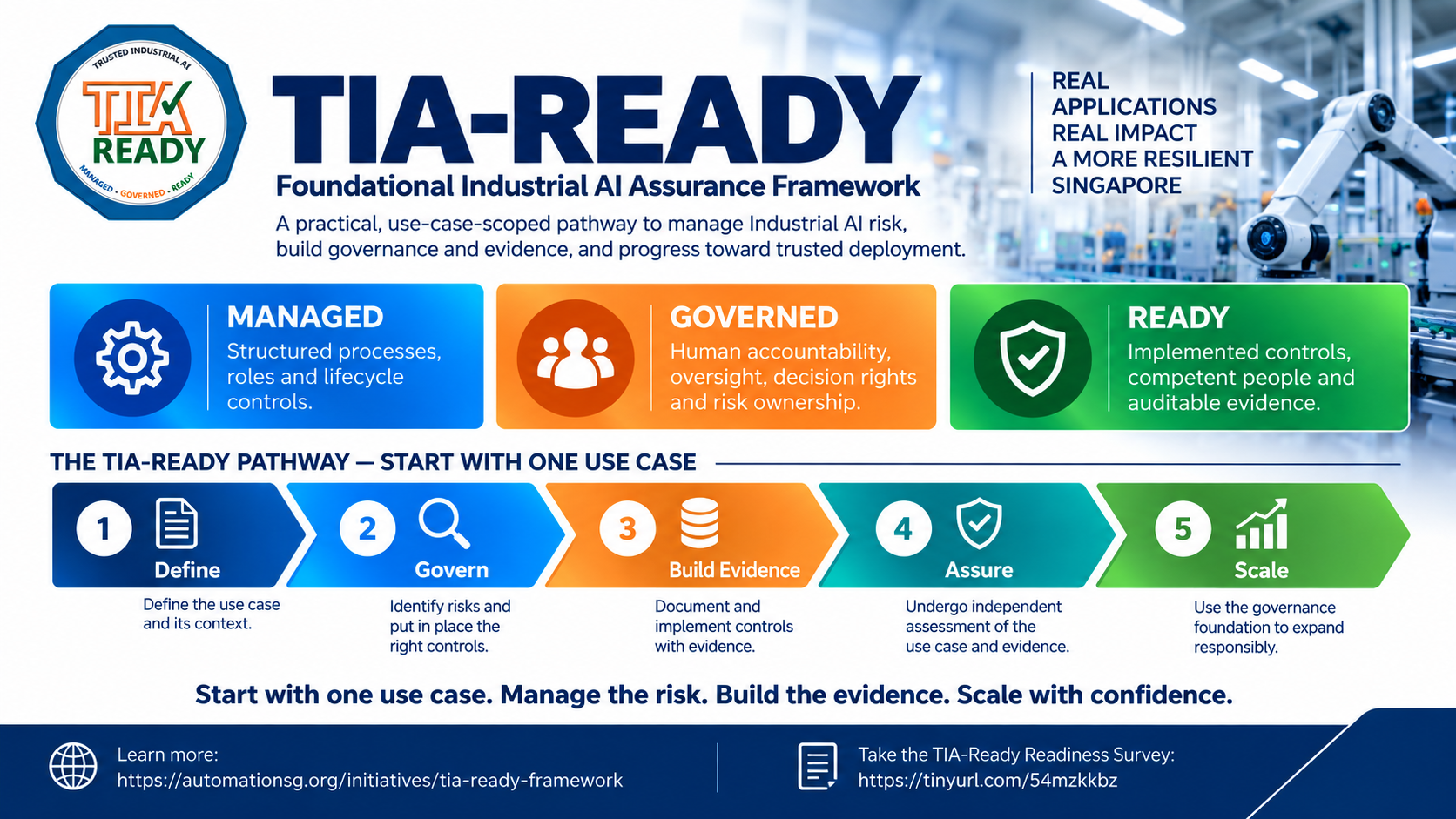
The infographic summarises the TIA-Ready approach: make a defined Industrial AI use case Managed, Governed and Ready, then progress through:
Define → Govern → Build Evidence → Assure → Scale
The objective is to establish a disciplined starting point, learn from a real deployment and extend that capability as AI adoption matures.
Start by defining what the AI actually does
Before an organisation can govern an AI system properly, it needs to understand exactly what the system is being asked to do.
A defined use case establishes its intended purpose and exclusions; users; data; operating boundaries; decision influence; autonomy; human oversight; connection to operational technology (OT), where applicable; possible consequences; and lifecycle monitoring.
Instead of saying, “Our company uses AI,” the organisation can describe a specific deployment: what it does, where it operates, who remains accountable and what controls surround it.
Once those boundaries are clear, risks can be examined, responsibilities assigned, controls implemented and evidence collected.
Managed • Governed • Ready
TIA-Ready describes the objective through three connected dimensions.
Managed means the deployment operates within structured processes, defined roles and lifecycle controls.
Governed means there is clear human accountability, oversight, decision rights, escalation and risk ownership.
Ready means appropriate controls have been implemented, competent people are involved and reviewable evidence exists to demonstrate that governance works in practice.
Governance must translate into operating processes, implemented controls and evidence.
A practical progression
The TIA-Ready pathway follows five practical steps.
Define. Establish what the use case does, what it does not do and where its boundaries sit.
Govern. Identify relevant risks, assign accountability, establish appropriate human oversight and put proportionate controls around the deployment.
Build Evidence. Retain evidence showing that those controls operate in practice. Depending on the use case, this may include policies, approvals, risk assessments, test and monitoring records, access or change logs, incident records and competency records.
Assure. Have the defined use case and its evidence independently assessed where applicable.
Scale. Reuse governance structures, templates, processes, risk methods, training and evidence practices as additional AI use cases are introduced.
The objective is to create reusable organisational capability.
Good governance should not become a barrier to adoption
Many organisations are still adopting AI in pockets and may not yet know what their eventual enterprise-wide AI architecture will look like.
That matters because good governance should enable responsible AI adoption — not become an obstacle to it.
For small and medium-sized enterprises (SMEs), particularly those still experimenting with AI use cases, moving immediately into comprehensive certification such as International Organization for Standardization/International Electrotechnical Commission (ISO/IEC) 42001:2023, or a broader AI quality-management standard such as European Standard (EN) 18286:2026, may be premature.
ISO/IEC 42001:2023 is an international AI management-system standard, while EN 18286:2026 addresses quality-management-system requirements for organisations providing AI systems for European Union (EU) AI Act regulatory purposes (European Committee for Standardization, 2026; International Organization for Standardization, 2023). ISO describes ISO/IEC 42001 as specifying requirements for establishing, implementing, maintaining and continually improving an AI management system. EN 18286:2026 was published in 2026 specifically for AI Act regulatory purposes.
Both take a broader organisational management-system approach than governing a single bounded AI use case. For organisations still learning what they will deploy, that wider scope can create substantial implementation, documentation and assessment demands.
Applied too early, that burden can slow deployment, increase the cost of bringing AI-enabled solutions to market and reduce the speed at which organisations learn from real implementations.
But doing nothing is not a credible alternative either.
Customers and other stakeholders increasingly want confidence that AI risks are understood, people remain accountable, appropriate controls are in place and there is evidence showing how the system is governed.
TIA-Ready is intended to address this practical assurance gap through a bounded, evidence-based approach (AutomationSG, 2026).
A defined use case gives organisations something manageable to govern: ownership is clearer, controls match an actual deployment and evidence is built around something operating in the real world.
Govern enough to build trust. Keep it proportionate enough to keep moving.
One technology, different governance
Two AI systems may use similar technology but create different risk.
A recommendation reviewed by an experienced employee is not the same as a system feeding decisions directly into an operational workflow with limited human intervention.
Influence, autonomy, oversight, reversibility and consequence all matter. That is why TIA-Ready starts with the specific use case and operating context.
From one use case to organisational capability
The first governed use case may establish roles, approval processes, risk methods, monitoring practices and evidence templates that can be reused as additional use cases are introduced.
Govern something real. Learn from it. Preserve the evidence. Reuse what works.
This allows organisations to progressively build a portfolio of governed AI deployments rather than treating each new application as a completely separate governance exercise.
Building towards broader standards
TIA-Ready is not an alternative to ISO/IEC 42001:2023 or EN 18286:2026, nor does TIA-Ready Recognition demonstrate conformity with either standard.
It is intended as a practical foundational step for organisations that need credible, evidence-based AI assurance while their AI adoption and governance maturity are still developing.
As more use cases are governed, the resulting policies, risk processes, controls and evidence may provide useful foundations for future standards or certification readiness. Formal conformity assessment or certification remains a separate process with its own scope, requirements and assessment (AutomationSG, 2026).
The key takeaway
You do not need to govern all AI at once. Start with one use case and govern it properly.
Define what it does. Understand what it can influence. Establish accountability. Put appropriate controls in place. Build evidence. Learn from the deployment. Then scale.
Govern enough to build trust. Keep it proportionate enough to keep moving.
Start with one use case. Manage the risk. Build the evidence. Scale with confidence.
In the next article, we will look at the 10 TIA-Ready Governance Domains that provide the governance structure around each defined Industrial AI use case.
Important: The use cases, risks, controls, evidence examples and TIA-Ready domain mappings discussed are illustrative and non-exhaustive. Actual applicability, risk classification, control requirements and evidence expectations depend on the specific AI deployment, use-case scope, operating context and risk profile. The implementing organisation remains responsible for its AI system, deployment, risk management, mitigation, legal and regulatory obligations and ongoing governance, working with its appointed consultant and independent assessment body where applicable.
Find out more:
https://automationsg.org/initiatives/tia-ready-framework
TIA-Ready Readiness Survey:
https://tinyurl.com/54mzkkbz
References
AutomationSG. (2026). TIA-Ready framework.
https://automationsg.org/initiatives/tia-ready-framework
European Committee for Standardization. (2026). Artificial intelligence—Quality management system for EU AI Act regulatory purposes (EN 18286:2026).
International Organization for Standardization. (2023). Information technology—Artificial intelligence—Management system (ISO/IEC 42001:2023).